Wondering whether South Lake Tahoe’s California side or Nevada side is the better fit for your next move, second home, or investment? It is a smart question, because this is not just a lifestyle choice. In practice, you are comparing two different ownership environments with different tax structures, school districts, short-term rental rules, and amenity patterns. If you understand those differences early, you can make a cleaner decision with fewer surprises after closing. Let’s dive in.
Why the state line matters
In South Lake Tahoe, the California side generally operates under City of South Lake Tahoe rules and California tax law. The Nevada side around Stateline and Zephyr Cove falls under Douglas County and Nevada law. That split can affect your costs, your use of the property, and even your day-to-day routine.
For many buyers, the choice starts with scenery or feel. But the better approach is to look at how you plan to use the home. A full-time residence, a second home, and an investment property can each point you in a different direction.
Compare taxes and carrying costs
Income tax and residency
One of the biggest headline differences is state income tax. Nevada does not impose a state income tax on individuals, while California residents are taxed on worldwide income. That said, buying on the Nevada side does not automatically make you a Nevada resident for tax purposes.
California residency depends on facts and circumstances, including domicile and whether your time in the state is temporary or transitory. If you are relocating and tax treatment matters to your planning, the address alone is not the whole story. You need to think through how your residency facts line up before assuming a tax outcome.
Sales tax differences
Sales tax is another practical cost that can show up over time. As of the current rate schedules referenced in the research, South Lake Tahoe’s combined sales tax rate is 8.75%, while Douglas County’s sales tax rate is 7.10%. That gap can matter when you are furnishing a home, buying materials, or completing updates after closing.
For a second-home buyer outfitting a property from scratch, this is more than a technical detail. Furniture, appliances, finishes, and contractor-related purchases add up quickly. Over time, lower transaction taxes on the Nevada side may become part of the overall ownership math.
Property tax mechanics
Property tax works very differently on each side of the state line. In California, Proposition 13 shapes the system, with the general property tax rate limited to 1% and annual increases in assessed value generally capped at 2% unless there is a change in ownership or new construction. In Nevada, Douglas County states that property is assessed at 35% of taxable value, with rates capped under state law.
The key takeaway is simple: similar purchase prices do not guarantee similar tax bills. Because the systems use different mechanics, it is important to evaluate each property on its own numbers instead of assuming the state line tells the full story.
Understand short-term rental rules first
California-side rental rules
If you are considering a vacation home rental on the California side, start with parcel-level eligibility. The City of South Lake Tahoe requires a valid vacation home rental permit to operate or advertise a short-term rental for fewer than 30 consecutive days. Permits are renewed annually, properties must pass an on-site inspection, and occupancy is limited by paved parking and bedroom count.
The city also states that only one vacation home rental may operate per parcel. Just as important, the regulatory environment changed again in 2025. That means broad assumptions about a neighborhood are not enough. You need to verify the specific property.
Nevada-side rental rules
On the Nevada side, Douglas County requires a vacation home rental permit for rentals of less than 28 days. Tahoe Township is capped at no more than 600 permits, and the county also limits density by neighborhood. As of April 27, 2026, Douglas County reported 556 permits, with several neighborhoods already full and on a waitlist, including Lake Village, Tahoe Beach Club, and Zephyr Heights/Knolls.
This creates a different kind of constraint. On the California side, the first question is often whether the parcel is eligible under city rules. On the Nevada side, the first question may be whether permit capacity is still available in that neighborhood at all.
Why investors should model carefully
If you are underwriting a property as an investment, permitability should come before projected income. Both sides have local compliance requirements, and both sides also impose lodging-related taxes that affect revenue. In South Lake Tahoe, transient lodging is subject to the city’s TOT and tourism fee, with city materials describing a total TOT of 12% or 14% depending on property type and location.
In Douglas County’s Lake Tahoe Township, the county lists a 14% room tax plus a $5 per room per night surcharge. The county also states that non-permitted short-term rental properties still owe room taxes, penalties, and interest for all nights rented. In other words, local rules are part of the financial model, not a box to check later.
Look at schools and daily logistics
California-side school district
On the California side, Lake Tahoe Unified School District serves about 3,900 students. The district includes one comprehensive high school, one middle school, four elementary schools, and one continuation high school. For households planning a full-time move, this structure may shape commute routes, scheduling, and where you focus your home search.
Nevada-side school district
On the Nevada side, Douglas County School District serves lake-area communities from Glenbrook to Stateline. Its lake-area schools include Zephyr Cove Elementary School and George Whittell High School in Zephyr Cove. Whittell follows a four-day school week, which can be a meaningful difference depending on your household routine.
If you are relocating full time, think beyond the view or lot size. School assignment, weekly schedule, and the rhythm of daily transportation can have just as much impact on your quality of life.
Compare lifestyle and amenity access
California-side beaches and boating
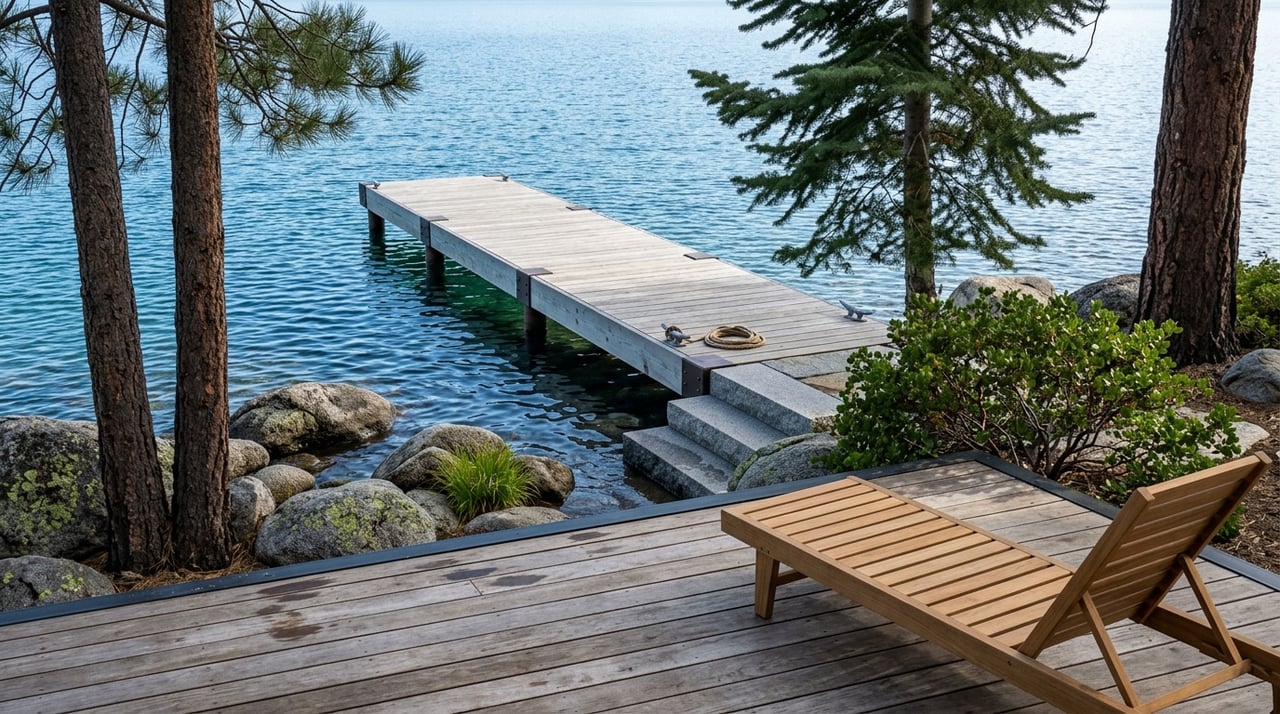
Buyers who want easy access to South Lake Tahoe’s city beach network may find the California side especially appealing. The City of South Lake Tahoe lists Lakeview Commons and El Dorado Beach, Regan Beach, and Conolley Beach as city beaches. Public boating access and marina options in South Lake Tahoe include places such as Camp Richardson Marina, El Dorado Beach Boat Ramp, Lakeside Marina, Regan Beach, Ski Run Marina Village, Tahoe Keys Marina, and Timber Cove Marina.
That concentration of beaches, parks, and boating facilities can be a strong match if your ideal Tahoe day includes walking to the lake, launching a boat, or staying close to the town’s civic core. For many second-home buyers, that convenience shapes how often they actually use the property.
Nevada-side beach and resort access
The Nevada side also offers strong beach-and-marina access, especially near the Stateline corridor. Nevada Beach sits about three miles north of Stateline on the east shore. Round Hill Pines Beach Resort & Marina offers day-use access, a marina and pier, and watercraft rentals, while Zephyr Cove Resort offers private beachfront access, lake cruises, and marina boat rentals.
If you want a resort-oriented experience close to Stateline, the Nevada side has a clear draw. It can feel especially convenient for owners who prioritize marina access, organized recreation, and a more amenity-driven setup.
Casino and nightlife convenience
One of the clearest location advantages on the Nevada side is casino access. The main casino corridor is concentrated in Stateline, including Bally’s Lake Tahoe, Harrah’s Lake Tahoe, Golden Nugget Lake Tahoe, and Caesars Republic Lake Tahoe. If entertainment and nightlife are central to how you plan to use the home, Nevada often has the edge.
How to decide based on your goals
Best fit for second-home buyers
If your goal is a retreat with strong access to city beaches, parks, and South Lake Tahoe’s town core, the California side may feel more aligned. If your goal is easier access to Stateline amenities, casino entertainment, and Nevada’s lower sales-tax and no-state-income-tax structure, the Nevada side may make more sense.
This is where personal use matters most. The right choice is usually the side that matches how you will spend your time, not the side that sounds better in theory.
Best fit for relocators
For full-time moves, focus first on school assignment, daily routine, and tax residency planning. Lake Tahoe Unified and Douglas County School District have different structures, and California residency rules mean that owning on the Nevada side does not by itself change your tax residency. If you are making a permanent move, lifestyle logistics should be evaluated alongside the financial picture.
Best fit for investors
For investors, the answer is usually more operational than emotional. You need to confirm permit status, lodging-tax impact, occupancy limits, and any HOA restrictions before projecting returns. A property can show well and still miss your investment criteria if the permit path is weak or the carrying costs are higher than expected.
A simple rule of thumb
If you want beach access and closeness to South Lake Tahoe’s city amenities, start your search on the California side. If you want Stateline resort convenience and Nevada’s tax structure, start on the Nevada side. If you are buying for rental use, verify permit eligibility before you let lifestyle preferences guide the decision.
In a bi-state market like Tahoe, small details can have outsized consequences. The most successful buyers usually narrow the choice by use case first, then compare specific properties inside the state framework that best fits their goals.
If you are weighing the California and Nevada sides of South Lake Tahoe, working with an advisor who understands cross-border ownership issues can save time and reduce friction. For tailored guidance on Tahoe property strategy, second-home buying, or investment opportunities, schedule a consultation with Scott Beenk.
FAQs
What is the main difference between South Lake Tahoe’s California and Nevada sides?
- The main difference is that they operate under different state and local rules, which can affect taxes, school assignment, short-term rental eligibility, and access to certain amenities.
Does buying on the Nevada side of South Lake Tahoe make you a Nevada tax resident?
- No. Nevada does not impose state income tax on individuals, but buying there does not automatically make you a Nevada resident for tax purposes because residency depends on your overall facts and circumstances.
Are short-term rental rules the same on both sides of South Lake Tahoe?
- No. South Lake Tahoe requires a valid city permit for rentals of fewer than 30 consecutive days, while Douglas County requires a permit for rentals of less than 28 days and also uses permit caps and neighborhood waitlists in Tahoe Township.
Which side of South Lake Tahoe has better beach and marina access?
- Both sides offer strong lake access, but the California side is closely tied to South Lake Tahoe’s city beaches and multiple boating facilities, while the Nevada side offers strong resort-style beach and marina options near Stateline, Round Hill Pines, and Zephyr Cove.
Which side of South Lake Tahoe is better for casino access?
- The Nevada side is better for casino access because the main casino corridor is concentrated in Stateline, Nevada.
What should investors verify before buying in South Lake Tahoe?
- Investors should confirm parcel or neighborhood permit status, local lodging-tax obligations, occupancy rules, and any HOA restrictions before relying on projected short-term rental income.